
Giant Incisional Hernia Surgery
Giant Incisional Hernia Surgery- As Surgeons, We Often Encounter Patients Who Have Lived with a Condition for So Long That It Has Become a Silent, Heavy Part of Their Daily Identity. Two Weeks Ago, I Operated on a Case That Perfectly Illustrated This Clinical Endurance. The Patient Presented with A Massive, Protruding Abdominal Mass—A Giant Incisional Hernia—That Had Reached a Stage Where Surgical Intervention Was No Longer a Choice, But A Necessity for Survival.
The Clinical Presentation
The patient arrived with a significant history of prior abdominal surgery. Over several years, they noticed a small bulge at the site of the old scar. However, like many patients facing the daunting prospect of another operation, they waited. Slowly but surely, the abdominal wall gave way. By the time they reached my clinic, the “bulge” had transformed into a large, pendulous sac containing a significant portion of their abdominal contents.
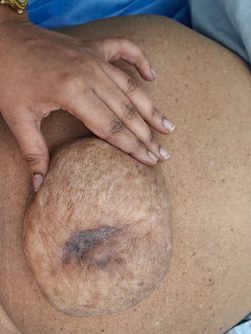
Upon examination, the skin over the hernia was thin and discolored, showing signs of chronic tension. The sheer volume of the herniated viscera meant that the abdominal cavity itself had physically shrunk because it no longer had to hold the intestines. This “loss of domain” is one of the most challenging hurdles in hernia repair, as forcing the organs back into a now-constricted space can lead to respiratory failure or “abdominal compartment syndrome.”
Navigating the Surgical Complexity
We planned a meticulous laparotomy to return the contents to their rightful home and reinforce the abdominal wall. As we made the initial incision, the complexity of the case became immediately apparent.
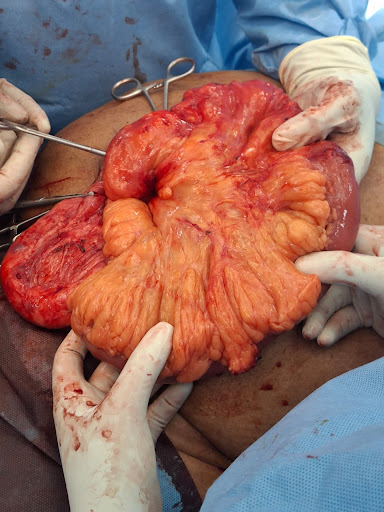
Inside the hernia sac, we found the greater omentum and several loops of the small intestine bound together by dense, fibrous adhesions. You can see in the intraoperative photos the thickened, fatty appearance of the omentum. It had essentially become a permanent resident of the hernia sac. My team and I spent hours performing a careful adhesiolysis—patiently separating the delicate bowel from the sac wall and from itself. We had to ensure every millimeter of the intestinal tract remained viable and free of injury.
Once we successfully reduced the contents back into the abdomen, the next challenge was the “closure.” A simple primary repair is impossible in cases this large because the tissue is too weak and the gap is too wide. Instead, we utilized a tension-free mesh repair. By placing a high-quality prosthetic mesh, we provided a new “scaffold” for the abdominal wall, distributing the pressure evenly and significantly reducing the risk of a recurrence.
The Human Element of Recovery
Surgery is rarely just about the technical maneuvers in the operating room. For this patient, the physical transformation was immediate, but the physiological adjustment took time. For the first few days post-op, we closely monitored their breathing. Because the diaphragm was now pushed upward by the returned organs, the lungs had to work harder to expand.
Fortunately, the patient showed remarkable resilience. By the end of the first week, they were walking with a much-improved posture, free from the heavy, dragging sensation that had plagued them for years.
Lessons for the Medical Community
This case serves as a vital reminder for both clinicians and patients: hernias do not heal on their own. While not every small bulge requires immediate emergency surgery, waiting until a hernia reaches a “giant” status exponentially increases the surgical risk and the complexity of the recovery.
Early intervention allows for laparoscopic approaches and faster healing. When we wait until the skin is compromised and the “domain” is lost, we move into the realm of high-stakes reconstructive surgery. Two weeks post-operation, I am happy to report that the patient is recovering well, reminding us of all that even the most daunting physical burdens can be lifted with the right surgical approach and a bit of patient courage.